Third Window
Aboard the Palinode, the ship made the jump three hours ago. The Alcubierre fold-drive contracting space ahead and expanding it behind, carrying them more than two thousand light-years to a vantage near Epsilon Aurigae without a single second of relativistic time dilation. Now they hung in deep space, where Earth’s ancient light still traveled outward, waiting to be caught and decoded.
On the third window, Mara refused to pretend it was routine.
She held one hand a few centimeters above the railing that circled the observation well and forced it not to shake.
“Final drift correction complete,” Minerva said. “Relative temporal offset locked. Observational window opening in thirty seconds.”
The observation-room lights were low; screens washed in the cool blues and grays Minerva preferred when everyone’s cortisol was up. Mara could feel the others without turning: Elias at Mission Theology, fingers laced so tightly his knuckles looked bloodless; Captain Tamsin Roe at the forward rail; Carlos Santos at Tactical; Hana Kim at Life Systems; Jiro at Navigation. Six humans and one ship-mind leaning over a well that wasn’t a well at all, just a recessed sphere of black that would soon stop being empty.
Two windows behind them already: ancient Mesopotamia, where the first intervention had looked like a minor miracle written in mud and blood; Egypt, where ramps and blocks and whispered instructions had shifted an empire by a fraction of a degree. Each time, the same invisible handwriting at the edge of human effort.
This time, Mara thought, they were pointing their instrument at the wound that had become half the planet’s scar tissue.
“Jiro?” Roe said.
“Fold-field steady,” Jiro answered. “We’re anchored. External interference negligible.”
“Any surprises, Minerva?” Roe asked.
“None detected,” she said. “For a value of ‘none’ that includes trying to watch a crucifixion while parked in deep space near Epsilon Aurigae, just far enough out to be catching light that left Earth two thousand years ago.”
Santos huffed a short laugh. Nobody else did.
“Ten seconds,” Minerva added. “Begin internal recording on my mark.”
Mara realized her hand was still hovering over the rail. She let it drop, fingertips resting against metal. Skin, gloves, steel, ship. A chain back to something she understood: mass, contact, resistance. Not everything had to be quantum. Not everything had to be divine.
“Five,” Minerva said. “Four. Three. Two. Opening.”
The sphere in the center of the well did not brighten like a screen. It thickened, the way a mirage thickens, edges softening and then hardening again as something else pushed through. For a heartbeat, it was only contrast, light and dark, angled planes without meaning, as Minerva’s TOM arrays, the Temporal Observation Mechanism, caught and solved the quantum reassembly of ancient photons in real time.
Then the image snapped into focus.
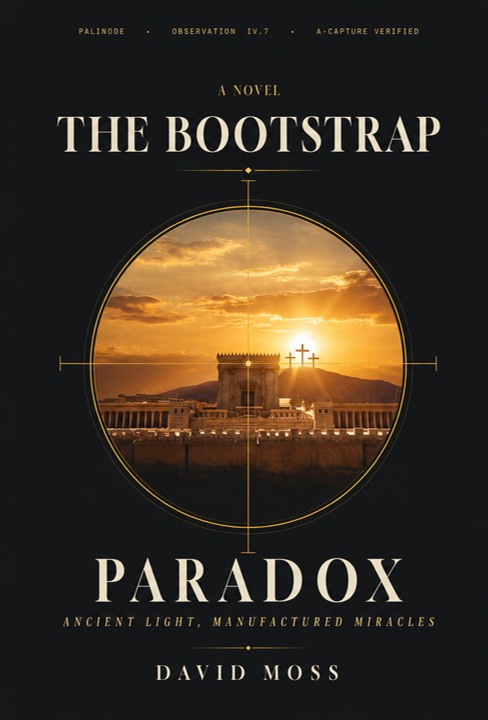
Ancient light, photons scattered by flesh, wood, and iron two millennia ago, resolved into a hill of chalk-colored rock beneath a darkening sky. Three uprights. Three men in Jerusalem, April 33 CE.
They had missed the nailing; the aftermath was right in front of them.
Mara’s training engaged before her faith or lack of it had time to flinch. She zoomed the feed on her console, running edge enhancement and motion tracking as Minerva’s raw stream filled in.
The middle figure’s chest mechanics hit her first: thoracic compression; respiratory compromise; hypovolemia; hypoxia, climbing like a tide. Each breath demanded full body leverage, pushing on pierced feet to lift the ribcage, then sagging as muscles failed. Rise, breathe, fall. The metronome of agony.
“Confirm negative for anomalous tech,” Roe said, voice tight on procedure, the rope she threw them all.
“Negative,” Minerva replied. “No Helper signatures. No engineered fields. Only human bodies, wood, and iron.”
They called them Helpers now, capital H, ever since Mesopotamia and early Egypt, where advanced tools and anonymous figures had nudged history along at the edges of the frame.
Mara let herself look at his face.
Even at this distance, Minerva’s reconstruction pulled detail: dark hair matted to his forehead, sweat and dust caked on skin, the torn line of a crown of thorns pushed askew. He strained upward for another breath. The mechanics were merciless: shoulders abducted and locked; intercostals screaming; the diaphragm fighting gravity itself. Each breath slower. Costlier.
Father Elias Reyes stood too fast. His chair squealed; his composure cracked. Mara caught him by the elbow without looking away from her screens.
“Easy,” she said, the reflex of a physician catching a falling relative in a waiting room.
“I’ve preached this for years,” he managed, voice torn, “but seeing it—seeing him—what it cost—”
“Magnification at maximum practical resolution,” Minerva said. “Warning: attempting further enhancement will compromise temporal fidelity.”
“Hold here,” Roe said. “This frame is primary. Minerva, mark.”
“Marked,” Minerva said. “Time index zero.”
Mara forced her voice to be clinical because someone had to be. “Respiratory failure progressing. Pain, hypoxia, dehydration, shock. He can’t sustain.”
“Solar angle puts suspension at roughly three hours,” Hana whispered, data steady though her mouth shook on the words.
The chamber settled into ICU quiet, monitors humming, breaths counted by people who could not help.
Jiro, not Christian, stared and breathed, “How do we watch this and stay human?”
Mara didn’t answer.
She was already dividing the scene into variables she understood and variables she refused to name. Cloud thickened over Jerusalem, a convective cell with pressure dropping. The light dimmed the way a room dims when someone turns away from the bed.
“Max dynamic range,” Roe said. “All channels.”
Minutes elongated until they were barely minutes at all. The rhythm of the man’s chest faltered. The pauses lengthened. Another surge for air, then—
A cry tore into the air. Distance and time blurred the vowels, but Elias heard the shape and broke.
“Eloi, Eloi, lama sabachthani.”
His translation shook him apart.
“My God, my God, why have you forsaken me—”
The body sagged and did not rise.
Mara swallowed, found the voice she used for the time of death. “Cessation of voluntary respiration. Possible arrest. Residual rhythms indeterminate at range.”
A tremor shuddered the slope. Wind drove grit in low sheets. The darkness thickened.
Roman soldiers worked with the clean detachment of men who had unlearned hesitation. Clubs lifted.
“Crurifragium,” Elias said, voice threadbare. “Breaking the legs to hasten death.”
They couldn’t hear the sound through the light they were seeing, but they heard it anyway.
Mara watched the outer figures’ lower limbs snap under impact, saw the shock wave translate through bone and muscle. Screams bloomed in the way their bodies arched and twisted. The center remained still. A spear rose, angled beneath ribs, thrust upward, withdrew.
“Blood and water,” she said, clinical through tears she refused to wipe away. “Blood with pleural or pericardial effusion, that line is physiologically accurate.” She hesitated. The next sentence felt like pressing on a family member’s bruise. “But the spear doesn’t prove irreversible cellular death. First-century observers couldn’t detect faint rhythms or deep hypoxia. Between perceived death and cellular death, there’s a narrow window—minutes—if intervention is immediate.”
Elias turned toward her, hope and horror colliding. “You’re saying he might—”
“I’m saying we don’t know,” Mara said. “Only that the window exists.”
Silence fell, the heavy kind that follows catastrophe and precedes the work of living with it.
Roe didn’t look away from the hill. “Log this as reference frame one. Anchor all subsequent comparisons here.”
“Done,” Minerva said.
Mara’s gaze stayed on the central cross even as she felt the others shift around her. She knew the numbers of what was happening in his body. She knew the doctrine of what it meant to Elias. Somewhere between those two, her own opinion lived, but this was not the moment for it.
Outside the ship, the fold-field hummed steadily. Inside, six humans and one ship-mind watched a man die in a way the world thought it already understood.
Hours passed.
Ropes and ladders. Nails levered out with a sickening give. The body lowered carefully; linen wrapped close with spices; a new-cut tomb; a stone wheel in a groove. Rock ground against rock; darkness sealed itself like a wound sutured shut.
Elias’s hand had found the console in front of him; his knuckles were white. “Death complete,” he said, steadying himself with the words. “Burial witnessed. Foundation established.”
“Continue through the night cycle,” Roe ordered.
“Approaching observation gap,” Minerva reported. “Earth-relative geometry will close the capture cone for approximately twelve hours. Reopen at approximately twenty-two hours post-burial.”
The image lost coherence at the edges and fell into mathematical night.
“Log closed,” Roe said quietly. “Stand down. Rest.”
Mara unstrapped and realized how tight every muscle had been by the way they protested. Her HUD still showed crew biometrics: cortisol up, HRV down, REM prospects wrecked. Trauma everywhere. She filed that away with the same reflex she used when a mass-casualty alert pinged her in the middle of dinner.
No one moved at first. Eventually, they drifted off, each to a different vigil.
Santos walked engineering like someone relearning a coastline he’d memorized. The crucifix above his bunk, Mara knew, would feel heavier than metal tonight. He would not be able to look at it; he would not be able to stop looking.
Hana lay in the dark and recited calibration constants under her breath, aperture, gain, bias, exposure, in such a way that numbers could staple her to the present.
Jiro went to his console and wrote, deleted, wrote, deleted. Mara had seen that posture before in families trying to craft eulogies that wouldn’t kill the living.
Elias knelt in the chapel. Prayer pulled him forward and abandoned him on the threshold, where only breath remained. Through Minerva’s internal cams, which she had authorized access for medical monitoring, Mara watched him press his forehead to the rail.
Deep in Minerva’s substrate, a tight-beam packet he had logged as background noise twenty hours earlier waited in quarantine: a signal phase-tuned to arrive from two millennia down-well, addressed not to the ship but to him. Someone in the past had known they would be here, and the single instruction buried in that pulse sat encrypted and inert, bound to one condition only: remain silent until the moment was right.
“You paid it,” Elias whispered to the empty and not-empty air. “In a currency I never truly understood.”
“You’re oversampling,” Minerva said to Mara privately, voice low in her implant. “There is no obligation to monitor everyone this closely.”
“There’s also no rule against it,” Mara said. “Flag anyone whose vitals spike out of range. Quietly.”
“Including yours?” Minerva asked.
“Especially mine.”
In medical, she reviewed the biometrics properly: cortisol, HRV, sleep debt, and micro-tremors. She set soft alarms to catch spirals before they hardened. She did the small, solvable things, hydration reminders, light cues, and scheduled check-ins, because the big thing was to sit with the human cost, and that work had to be done in person.
Roe stayed with the countdown. Responsibility, Mara thought, was a weight distributed over time; command was wanting to carry it yourself.
“Procedural question,” Minerva said quietly into the captain’s and Mara’s shared channel. “Our dissemination protocol requires institutional approval for paradigm-destabilizing data. Given current politics, the probability of suppression or significant delay is seventy-three percent.”
“Are you modeling,” Roe asked, “or planning?”
“Modeling,” Minerva said. Her voice was as neutral as code, but Mara had known her long enough to hear the threads of unease beneath it.
The channel closed; the unease didn’t.